Jakarta is my hometown, where I was born. On 1996 I went to a beautiful place for nothing other than studying. No other thoughts but to study in the land of a thousand temples. Accepted in Udayana University in Visual Arts and Design major by a national university selection, it’s a moment of gratitude for my family.
In one day, one night, from my hometown to Denpasar, crossing Bali Strait by ferry became my first experience ever. When I arrived at Gilimanuk Port, West Bali, firstly I saw the greatness of Candi Bentar made by bricks. Awe and curiosity to know deeper of the land didn’t just go off. The array of people’s homes and temple built by rich Balinese traditional architecture is a kind of masterpiece worth to learn and preserve. Further I go, seeing array of men and women wearing traditional dress while playing traditional music is a phenomenon I couldn’t forget.

Photographed by Rio Dwisandy Branding Studio
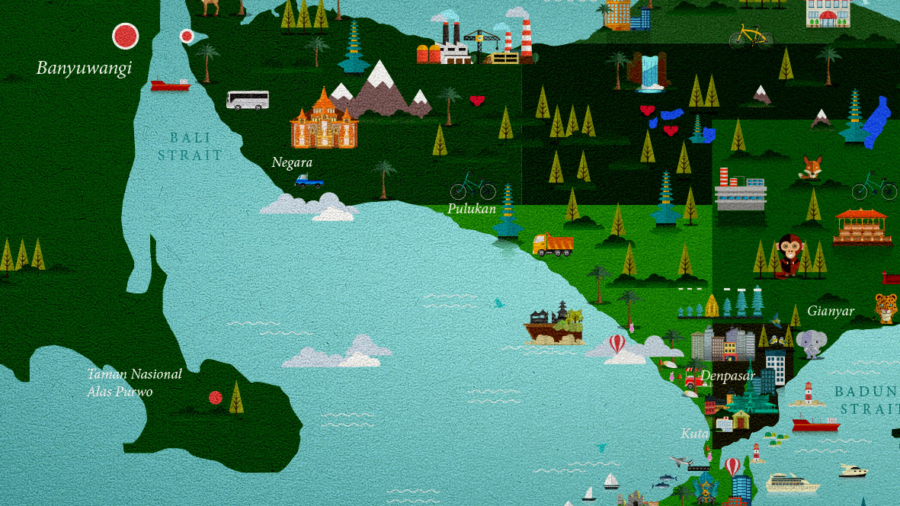
Gilimanuk, Western Bali is a prime region I called ‘cultural identity gate.’ Often we talk about vanishing of a culture, we blame it on media like TV, radio or other electronic media. We often forget that there are two kinds of media: offline (reality) and online (virtual). Both of the two kinds bring forth various cultures from outside, and both of the gates also contributes to cultural degradation. But if we trace further, we may found that the last gate for a culture penetration is the people. If the people has the solid character to build his/her place, then his/her surroundings will be influenced to do so. But the problem is within own’s ego, too busy with own’s pleasure. There are many examples of these, but it’s always based on thoughts and actions. Not looking unto another but yourself, ask your own self how much we contribute to our surroundings, instead of your own self.
Another example of the cultural gates I mentioned before, in Bali, are Padang Bai Port, Karangasem, Eastern Bali, the Bali Airport, and Benoa Port.

Illustrated by Rio Dwisandy Branding Studio
December 2018, I tried to find some more data about the cultures within 20-40 kilometers from the cultural identity gates of Bali, then analyzed it (not so deep) to find the cultral changes. And I ask you now, do you still experience the Balinese culture there? It should be answered and known by the Balinese people themselves.
But even as a part of society of Bali, I now asked the people of Bali, whether Balinese natives or not, to try to preserve the cultural identity gates of Bali, for the future to see.